
Choose a shipping scale for the parcels you actually prepare. Capacity alone is not enough: a large box can hide the display, touch the wall, or sit poorly on a platform even when its weight is below the stated limit.
This comparison uses manufacturer documentation checked October 5, 2026. We have not personally tested these scales or independently verified their accuracy. Display increments are not a promise of measurement accuracy.
Disclosure: This post contains affiliate links. If you purchase through them, we may earn a commission at no additional cost to you. See our Affiliate Disclosure.
Check whether the existing scale is sufficient
Use the finished parcel, including the product, outer package, protection, closure, and inserts. Confirm that the scale’s capacity, operating range, supported units, and measurement performance suit the service you use.
An existing household scale can be a starting option when it meets those needs. If the box obscures the display, touches another surface, exceeds capacity, or produces inconsistent readings, identify that specific failure before choosing a replacement. Do not tare away packaging that must be included in the shipping weight.
Three fit checks
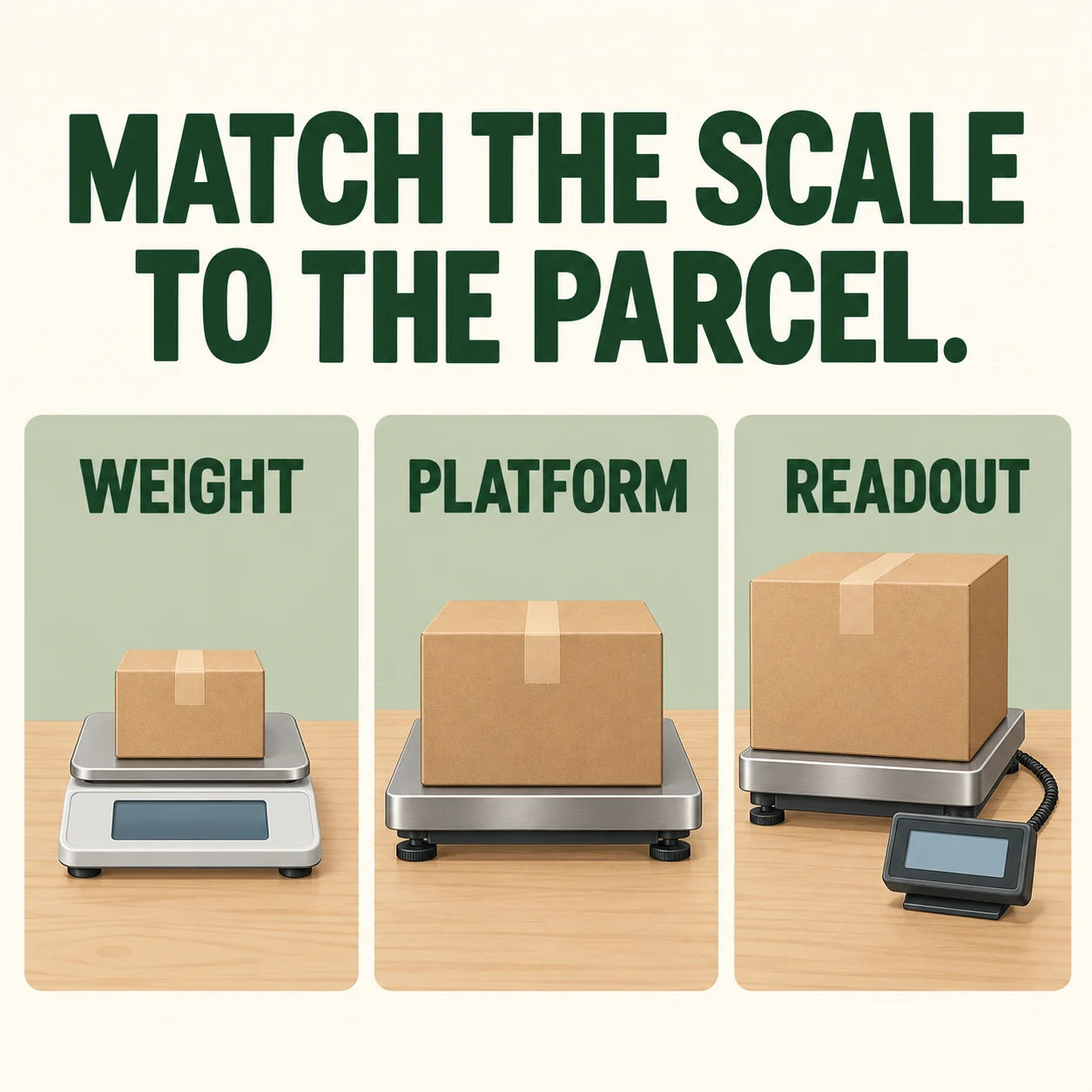
| Check | Question | Failure to look for |
|---|---|---|
| Weight | Does the working range cover the complete parcel? | Overload or too little usable detail for light parcels |
| Platform | Can the parcel sit stably without external support? | Box touching a wall, desk, cable, or another object |
| Readout | Can you read the settled result? | Display hidden by the usual parcel or inaccessible controls |
Four documented options to investigate
MUNBYN IPS01
Published capacity: Up to 66 lb; 0.1 oz displayed increment
Why examine it: Compact parcel/letter work; maker lists a fold-up mailer holder
DYMO M25 manual
Published capacity: 25 lb; 0.1 oz increment
Why examine it: Smaller parcels; manual separately states accuracy and USB/battery power
Brecknell PS25
Published capacity: 25 lb class; increments vary across the range
Why examine it: Letter/small parcel work with a flip-up support
MUNBYN IPS03
Published capacity: Up to 440 lb; confirm current increments in the model documentation
Why examine it: Heavier parcels when the platform and separate display arrangement fit
Check the current model, working range, units, and available configuration before ordering. A higher maximum capacity can come with coarser displayed increments, so the IPS03 is not automatically a better choice for light parcels.
The PS25 specification sheet gives different increments below and above 2 lb. The DYMO manual lists accuracy separately from increments. Compare the manufacturer’s actual measurement specifications rather than interpreting a decimal place as accuracy.
A compact option when the need is clear
If your finished parcels fit its working range and platform, and a letter holder is useful, the IPS01 is a MUNBYN option to examine. Its published minimum start weight is 5 g. Confirm the variant, current availability, and the measurement requirements of your shipping workflow.
When the parcel hides the display
A separate readout is a different need from higher capacity. First check whether the existing scale’s supported hold function lets you read the settled result after removing the parcel. If the normal box still obstructs weighing or controls, compare a separate-display arrangement.
The MUNBYN IPS03 is one candidate already listed above: the manufacturer provides a separate LCD display that stores behind the scale. Plan a visible readout location and a clear cable route, then check that the finished box rests on the platform without touching the wall or another surface. Confirm the current operating range, displayed increments, and platform dimensions in the exact model’s documentation. Its 440 lb maximum is not a reason to choose it for lightweight parcels; higher capacity alone does not establish the measurement detail you need.
Use the IPS03 manufacturer page to check the exact configuration. We have not tested its accuracy or hold behavior. If the current scale meets your parcel range and remains readable, retain it rather than adding a larger device.
Check the MUNBYN IPS03 separate-display scale →
This affiliate link leads to MUNBYN’s US store. Confirm the selected model, current availability, delivery region, and the requirements described above before ordering.
Make weighing a repeatable checkpoint
- Place the scale on the suitable level surface required by its instructions.
- Check the unit and zero state with the platform clear.
- Place the complete parcel so it is supported by the platform without touching another surface.
- Wait for the reading to settle and record the result with its unit.
- Measure the required parcel dimensions and use the current service’s entry rules.
- Keep the measurements connected to the same order before creating the label.
If you use a container only to support an item during another weighing task, understand the tare function and the scale’s remaining capacity. For shipping, the package itself remains part of the finished parcel.
Troubleshoot before replacing
| Symptom | Check |
|---|---|
| Reading changes repeatedly | Surface, placement, contact with nearby objects, power, and manufacturer instructions |
| Unexpected zero or negative value | Zero/tare state and the order of placing/removing items |
| Display is hidden | A supported hold function or a suitable separate display arrangement |
| Light parcel barely registers | Minimum operating weight and increments, not just maximum capacity |
| Shipping estimate still changes | Entered units, finished dimensions, and current service rules |
If the equipment’s performance remains uncertain, follow its calibration/checking guidance or seek manufacturer support. An approximate household object is not a certified calibration weight.
Record the scale decision
Write: usual finished weight range → largest parcel footprint → measurement needs → display location → storage position. Keep the existing scale when it meets the requirements; replace it only for a named failure.
Continue with Shipping Labels for the WEIGH → LABEL handoff and Packing Station for placement. The packing checklist provides a record of parcel checks without requiring another tool.