

A shipping-supplies checklist should produce a complete parcel and a reliable restock decision. Buying a large assortment of packaging does not help if the one mailer you use every day runs out or its reserve case fills the packing surface.
Start with your product’s packing recipe, current order volume, and supplier lead time. Keep essential supplies separate from optional presentation extras and equipment upgrades.
Disclosure: This post contains affiliate links. If you purchase through them, we may earn a commission at no additional cost to you. See our Affiliate Disclosure.
What the complete parcel needs
| Supply or capability | Purpose | Decision |
|---|---|---|
| Suitable outer package | Contain the actual order | Choose by product and current service requirements |
| Appropriate protection | Address the product’s damage risks | Match the material and method to the product |
| Secure closure | Close the parcel appropriately | Use a suitable method for that package |
| Supported label method | Attach the correct carrier label | Existing printer or supported alternative may suffice |
| Suitable scale and measuring tool | Record finished parcel details | Check the working range and required measurements |
| Order reference | Keep item, parcel, and label matched | Use a minimal reference at the workstation |
| Care/presentation inserts | Provide useful product information | Optional unless your product/process requires them |
Use the packing-recipe guide to define material quantities. A fragile item and a soft textile do not need the same method. Carrier-provided packaging also has service conditions; check the current carrier instructions before using it.
Separate working stock, reserves, and waiting orders
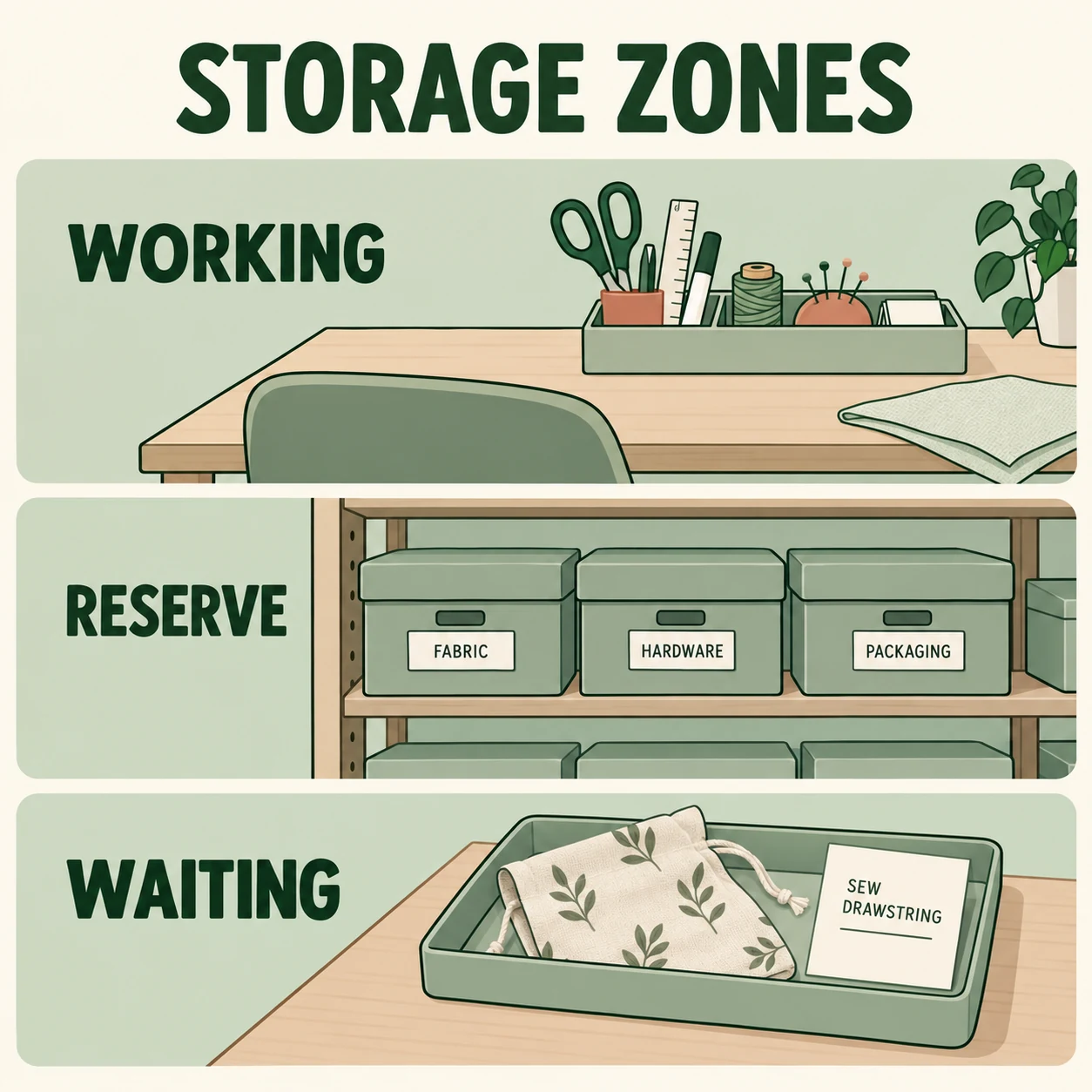
Working stock holds the quantities needed for an ordinary session. Reserves replace those supplies. Waiting orders have a hold reason and next action; they are not storage for unopened materials.
Use one accessible location for the most-used package size, closure material, and labels. Put backup cases in a separate identifiable position. Refill the working kit deliberately instead of allowing the entire case to remain on the packing desk. Keep unfinished parcels and checked outgoing parcels distinct.
Make one supply record per actual item
| Field | Example record |
|---|---|
| Identity | Mailer M1, exact size/material or supplier SKU |
| Used per order | One for the single-pouch packing recipe |
| Working quantity | Amount needed for your normal session |
| Reserve quantity and location | Count plus shelf/bin position |
| Supplier and lead time | Observed replacement source and delivery time |
| Reorder point | Expected use during lead time plus chosen buffer |
| Open orders / pending supply | Record separately to avoid double ordering |
The example is a fictional supply reference. Store the actual dimensions with units and the supplier item identity. Two similar mailers are not interchangeable if their usable dimensions or protection differ.
Calculate a reorder point from observed usage
A planning starting point is: daily use × supplier lead time in days + a buffer appropriate to variability. Use the same type of days in your consumption and lead-time records.
Illustrative example: 4 mailers per day × 5 days + a 10-mailer buffer = 30 mailers. At or below that level, review the order and replenishment plan. Do not automatically place an order without considering stock already on its way or a known change in demand.
Reorder point is different from order quantity. Choose the amount to buy using likely consumption, pack sizes, delivery cost, storage capacity, and how long the materials will remain suitable. For irregular demand, use a more cautious review rather than treating the example formula as a guarantee.
Avoid bulk purchases before the package fits
- Prepare a representative order with a modest quantity of the proposed supplies.
- Check the complete packing method and finished dimensions/weight.
- Confirm the package fits common order combinations.
- Record actual usage over normal sessions.
- Increase the reserve quantity only for the supplies that consistently serve those orders.
A low price per unit does not compensate for the wrong size, incompatible labels, or storage that blocks work. Retain the supplier reference for the proven item so reordering does not depend on a vague photo or remembered product title.
When equipment becomes a natural next step
Keep a suitable existing printer while it produces usable labels and handling is manageable. If cutting and attaching paper labels becomes a repeated bottleneck, compare a supported thermal printing route and its full footprint. The RW403B is one Bluetooth/USB option after those checks.
If the existing scale cannot handle your finished parcels clearly, compare capacity, platform support, and display visibility. The IPS01 is a compact option for parcels within its published range; confirm the actual variant and measurement needs before ordering.
These options are based on published specifications, not hands-on tests. Use the printer workflow comparison or scale comparison before deciding. Compatible label refills are a separate decision in Fanfold vs. Roll Labels.
When a label holder solves a supply-path problem
A holder is a separate decision from buying a printer. Consider one when an external roll needs support or compatible fanfold stock repeatedly loses its assigned position. Keep a stable existing arrangement if it already feeds correctly; a holder does not make incompatible labels work.
For a smaller separate supply holder: compare MUNBYN’s ILH01 Pink Small Holder. Its published dimensions are 7.4 × 5.62 × 5.47 inches; the stated limits are 4.76-inch label width, 6-inch roll outer diameter, and a minimum 0.74-inch roll core. Those are holder limits, not permission to exceed your printer’s media requirements. Measure the full operating layout and verify the selected variant; an existing stable fanfold box may still be enough.
Compare the MUNBYN ILH01 small holder and roll limits →
The MUNBYN holder page’s 941ST option is an alternative to evaluate for a dedicated label-supply position. The manufacturer describes roll and folded-stock support and lists dimensions of 10.35 × 6.69 × 8.85 inches. Measure that space plus the printer, cables, and clear feed path before ordering. Check your roll’s core and diameter, the holder’s limits, and the exact printer’s loading instructions; the holder’s product page does not establish compatibility with every printer or roll.
Check the MUNBYN 941ST holder option and dimensions →
These affiliate links lead to US-store pages for ILH01 and 941ST; the stated ILH01 dimensions refer to the Pink Small Holder. The 941ST page heading also uses ILH01, so confirm the selected holder option, current availability, and specifications rather than choosing by the heading alone. These are specification-based candidates; we have not tested their feeding performance or stability. For a table you clear after each session, compare the effort of storing this holder with your existing contained label kit.
Weekly supply review
- Reconcile working and reserve quantities for the most-used items.
- Check supplies committed to current orders and any delivery already pending.
- Review a repeated shortage rather than increasing every supply equally.
- Check that specialty or seasonal stock still has a use and a storage place.
- Refill the working kit and record the next reorder decision.
Use the daily and weekly routine guide to connect this review with order holds. The packing checklist helps check one parcel, while Packing Station helps place the supplies and equipment.
Troubleshooting the supply system
| Problem | Investigate |
|---|---|
| Same mailer runs out repeatedly | Actual usage, lead time, pending deliveries, and reorder point |
| Many sizes sit unused | Packing recipes and real order combinations |
| Labels are bought but cannot be used | Exact printer/media specifications and selected format |
| Reserve boxes fill the desk | Working quantity and a separate reserve location |
| Orders wait for a small missing item | Include it in the recipe and supply record |
The useful outcome is a small set of identified supplies with a working quantity, reserve location, and a reason to reorder. Complete that record before expanding the shopping list.